Hey there, fellow riggers, lifting ops managers, and anyone who’s ever squinted at a chain sling spec sheet wondering why that “safe working load” number isn’t as simple as it looks. I’m Jake, and for the last 12 years, I’ve run a small, no-BS chain sling and rigging hardware shop—we don’t do flashy marketing, just solid stuff that gets the job done and keeps guys safe. I’ve seen way too many near-misses because someone pulled a number out of their ass instead of actually checking what’s affecting that working load limit (WLL). Let’s break this down like we’re chatting over a coffee in my warehouse, no stuffy jargon, promise. Chain Sling and Hardware Riggings
First off, let’s get one thing straight: that WLL stamped on your sling or clevis isn’t a “one size fits all” safe load. It’s a baseline, and half a dozen things can chop that number in half (or worse) if you ignore them. I’ve been in the game long enough to know that even seasoned riggers skip a step here and there, so let’s hit the factors that matter most—starting with the chain itself, because that’s the backbone of every sling.
Chain grade is huge, and I’m not just talking about the random numbers stamped on the link. When we get a batch of grade 80 chain, it’s heat-treated with a specific alloy mix—chromium, manganese, that kind of stuff—so it’s stronger than grade 70, obviously. But here’s the thing: if you mix grades? Like, throwing a grade 80 master link with grade 70 chain? The WLL drops to the lowest grade in the chain, no exceptions. I had a guy come in last month panicking because his sling snapped mid-lift, and turns out he swapped a worn grade 70 link into a grade 80 set to save a buck. Dumb move, and it cost him a load. Also, don’t sleep on the manufacturing standards. We only use chain that meets ISO 1834 or ASME B30.2, because that’s not just paperwork—those standards test every batch for tensile strength, so you know you’re getting what you pay for. Cheap no-name chain from a random overseas seller? It might have the grade stamp, but it’s probably cut corners on the heat treatment, and that WLL is a lie.
Next up, the condition of the chain. Even the best grade 100 chain (the strongest stuff we carry) will fail if it’s beat to hell. Worn links are the big one—how much wear is too much? The rule of thumb I’ve used for years is if the link is worn 10% of its original diameter, you bin it. I’ve seen guys grind down a worn spot to “make it fit” a hook, and that’s a ticket to a bad day. Stretch is another one. A little stretch is normal, but if a link is stretched more than 5% over its original length, it’s not carrying load right anymore. Stretched links make the entire sling’s angle wrong, which we’ll get to in a sec. Also, damage like kinks—if you yank a chain too tight and bend a link into a kink, that’s a stress crack waiting to happen. I tell my guys to replace any sling with a kink immediately, no exceptions. And don’t forget corrosion—rust eats away at the metal, same as wear, so if your chain has significant rust pits, the WLL is down. We’ve had customers send us slings that were sitting outside in the rain for months, and half their links were pitted so bad we had to scrap the whole set.
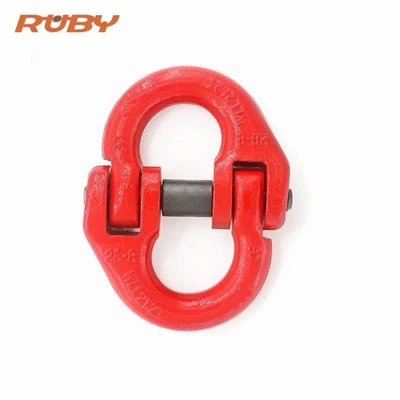
Now, the rigging hardware—this includes master links, clevises, hooks, all that stuff that connects the chain to the load and the crane. A lot of people treat these afterthoughts, but they’re just as important as the chain. First, hardware grade: same as chain, if your master link is grade 80, it needs to match the chain. Using a grade 43 clevis with a grade 80 sling? The clevis will snap before the chain hits its WLL. I see this all the time on job sites where guys grab whatever’s lying around instead of matching parts. Also, hardware condition: check for cracks, bent pins, worn threads on clevis pins, or any deformation. A bent hook latch? That’s not a small issue—if the latch pops open mid-lift, the load is coming down. We had a customer a few months ago bring in a clevis with a hairline crack in the pin, and the WLL on that pin was effectively cut in half because that crack was a stress point. Oh, and don’t overwork hardware—like, if your master link has a worn side plate, that’s done. No amount of welding will fix it, and welding on rigging hardware is actually against ASME standards, so don’t even try it.
Here’s a big one that catches so many people off guard: the angle of the sling. That WLL number is only for a straight vertical lift. If you’re lifting a load at an angle—like, two slings coming off a crane hook at 30 degrees instead of straight down—the WLL drops hard. Let’s do a quick example: if a single sling has a WLL of 10,000 lbs vertically, at a 60-degree angle, each sling is carrying way more than half that load, so the effective WLL per sling is more like 7,000 lbs. At 30 degrees? It drops to 5,000 lbs. I’ve seen job sites use that wrong angle and end up with a load crashing because they thought “it’s two slings, so 20k lbs is fine.” Nope, that angle kills it. The rule I teach all our regular customers is to keep sling angles at 45 degrees or higher if you can, and never go below 30 degrees unless you use rated shackles and adjust for the angle factor. A lot of people don’t realize that the angle isn’t just about the slings—it’s the hardware too. Clevises and master links have their own angle ratings, so even if your chain is good, if your master link isn’t rated for the angle you’re using, that’s another failure point.
Wait, what about dynamic loads? That’s another one that’s super important, especially on construction sites or warehouses with heavy moving loads. Static WLL is for when you lift slow, steady, no sudden movements. But if you’re yanking a load off a truck fast, or swinging it, that’s a dynamic load, which multiplies the force on the sling. We always tell people to add a 25% safety factor to WLL for dynamic lifts, because sudden jerks can double the load in a heartbeat. I remember a time at my shop where a guy was lifting a 5,000 lb engine and dropped the hook suddenly—sling snapped, luckily no one got hurt, but it was because he didn’t account for the dynamic force. Even slinging a load and setting it down fast counts, so don’t ignore that.
Also, the type of hitch you’re using. There are four main hitches, right? Vertical, basket, choker, and each has its own WLL. A basket hitch—where you run the sling under the load—has a different WLL than a vertical hitch with the same chain. Choker hitches, where you loop the sling around the load and hitch it to itself, have a lower WLL too, because the choke point creates friction that concentrates stress on one part of the link. I’ve seen choker hitches used on loads that are too big, and the link bends right at the choke. Always check the hitch rating for your specific sling, not just the base WLL. And don’t get a choker hitch confused with a basket hitch—people mix those up all the time and end up overloading.
Wait, let’s not forget about side loading. That’s when you’re pulling or dragging a load with a sling, not just lifting it vertically. Side loading puts all the stress on one side of the hardware or chain, way more than a straight lift. For example, if you use a clevis to pull a load sideways, the WLL is way lower than its rated vertical WLL. We had a customer try to drag a steel beam across a yard with a clevis that was only rated for vertical lifting, and the clevis bent in half. Side loading is a no-go for most hardware and slings unless they’re specifically rated for it. Always lift straight when using your rigging—no pulling sideways, no dragging loads with slings, that’s just asking for trouble.
Now, let’s talk about something a lot of people don’t mention: heat and cold. The environment you’re lifting in affects WLL too. If you’re lifting in high heat—like, metalworking shops or construction in the desert above 200 degrees F—the metal of the chain and hardware weakens, so WLL drops. Conversely, in extreme cold, below -40 degrees F, metal becomes brittle, so it’s more prone to snapping, and WLL drops too. We used to sell a bunch of grade 80 chain to a construction company working in Alaska, and they had to upgrade to grade 100 because their regular chain was failing in the deep cold. They said the WLL was down almost 20% at -50 degrees, so that’s a huge factor. If you’re lifting in extreme temps, make sure your rigging is rated for that environment, not just the base WLL.
I’ve been doing this long enough that I can spot a rigging job that’s going to go wrong before the lift even starts. I’ve seen guys check the WLL, but not the grade, not the condition, not the angle, not the hitch, not the environment. All those factors add up, and missing even one can lead to a disaster. That’s why at our shop, we don’t just sell you a chain sling and call it a day. We ask you questions: what’s the load? What’s the weight? How are you lifting it? What’s the environment? We even check the condition of hardware when you come by, because we want you to go home safe, not deal with a broken sling (or worse).
If you’re working with chain slings and rigging hardware, don’t take that WLL number for granted. It’s not a guarantee—it’s a starting point. Check the grade of every part, inspect for wear, damage, corrosion, make sure your angle is right, your hitch is rated, account for dynamic loads, and factor in the environment. Ignore any of these, and you’re rolling the dice.

If you need help picking the right sling for your job, or have questions about inspecting your rigging, hit us up. We’re here to make sure you have the right stuff, no games, no overcharging, just honest advice and solid gear. Let’s keep the job sites safe and the loads moving without the headaches.
Chain Sling References
ASME B30.20: Below-the-Hoist Lifting Devices
ISO 1834: Lifting chains – Grade T (8) and Grade W (10) – Requirements
OSHA 1910.184: Slings – materials, design, construction, care, and use
Hangzhou Ruby Imp. & Exp. Co., Ltd.
As one of the most experienced chain sling and hardware riggings manufacturers and suppliers in China, we offer a wide range of products with superior quality. We warmly welcome you to wholesale custom made chain sling and hardware riggings at competitive price from our factory.
Address: Taoyuan Industrial Park, Puyang Town, Xiaoshan, Hangzhou, Zhejiang, China.
E-mail: Sales5@z2lifting.com
WebSite: https://www.rubylifting.com/
